Molly Doane
.
Vince M. LaMotta
Assistant Professor

PhD, University of Arizona 2006
Room 2138-D BSB   (312) 413-8189   vlamotta@uic.edu
 
Return to Faculty

Anthropology Department Home

Contacts
Anthropology Program
Geography Program

Faculty
Staff
Graduate Students

UIC Home Page
     
Archaeological Method and Theory, Formation Processes, Zooarchaeology, Bioarchaeology, Ceramics, Religion and Ritual, Mortuary Behavior, Sociopolitical Complexity, Dating Techniques; North America, U.S. Southwest, Arizona, Pueblo and Ancestral Pueblo Cultures, Hopi
 

Current ResearchPast Research


Personal Statement

I am a Southwestern archaeologist with broad-based theoretical interests and an expansive, cross-cultural outlook. I specialize in zooarchaeology and ceramic analysis.

My research focuses on religion and ritual in ancient non-state societies, particularly among ancestral Pueblo cultures of the American Southwest. I am especially interested in understanding the role of ritual in the emergence of sociopolitical complexity in such societies. One aspect of my research concerns the emergence and elaboration of ritual sodalities in aggregated pueblo communities of the thirteenth and fourteenth centuries A.D. In collaboration with the Arizona State Museum’s Homol’ovi Research Program, my investigations focus in particular on the development of ritual complexity in villages of the Homol’ovi settlement cluster, a group of seven major pueblo villages in northern Arizona occupied from approximately A.D. 1260 to 1400. As these are ancestral Hopi sites, my work on Homol’ovi is especially pertinent to the study of Hopi history and culture.

I am also concerned with building methods and theory for discerning the impact of ritual behaviors on the archaeological record—a field one might call ritual formation processes. For example, my work in the Pueblo Southwest has explored site and structure termination rituals, and ritual processes impacting zooarchaeological and human osteological assemblages. I have also done work on variability in mortuary deposition in the Southwest and cross-culturally. I am interested in expanding these inquiries through ethnographic and ethnoarchaeological research, to better understand how people manufacture, use, reuse, and discard or abandon sacred objects and places, and to construct middle-range theory for building interpretations of ritual processes in antiquity.


Current Research

I will soon be launching a new zooarchaeological research project to study faunal remains from the Homol’ovi sites as part of my ongoing investigation of ritual elaboration in the Homol’ovi settlement cluster in the late fourteenth century. 

Additionally, I will be starting a joint project with the Peabody Museum of Archaeology and Ethnology, Harvard University, to analyze and publish materials from the Peabody Museum’s 1939 excavations at Pink Arrow, an ancestral Hopi site on Antelope Mesa in northern Arizona.  Pink Arrow is unique in that, with 50-100 rooms, it is among the smallest of the late prehistoric Antelope Mesa pueblos, which include the much larger and more well-known sites of Awatovi and Kawaika-a.  Analysis of ceramics from Pink Arrow, in particular, offers possibilities for refining the Pueblo IV period chronology of northern Arizona. 

In terms of future research, I am actively exploring a number of possible areas for upcoming fieldwork projects, including localities at Homol’ovi and in the Anderson Mesa region in northern Arizona.  Graduate and undergraduate students are welcome to inquire about participating in laboratory and field research projects.


Past Research

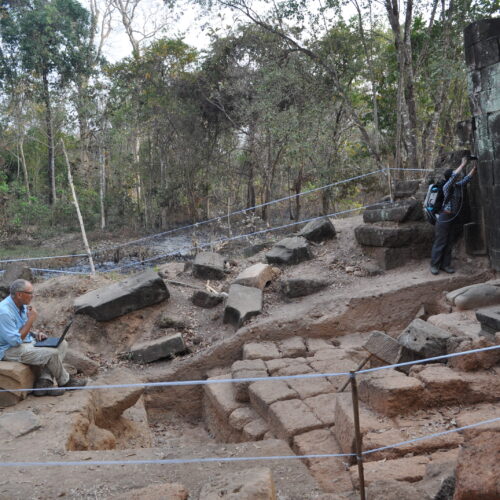
I have been engaged in archaeological research in the American Southwest since 1992.  I participated in fieldwork at Homol’ovi from 1994 to 1999, and based my master’s and dissertation research on the results of those excavations.  My master’s work concerned the deposition of human remains in structure termination rituals at Homol’ovi, while in my dissertation I developed a ceramic chronology for the sites and examined temporal trends in ritually sensitive fauna (e.g., birds, carnivores) over the occupation of the settlement cluster.  I have also excavated in California, New Mexico, and Israel.


Selected Publications:
2007 Ritual Zooarchaeology at Homol’ovi. Archaeology Southwest 21(2):10.

2007 (with Barnet Pavao-Zuckerman) Missionization and Economic Change in the Pimería Alta: The Zooarchaeology of San Agustín de Tucson. International Journal of Historical Archaeology 11:241-268.

2007 (with Michael B. Schiffer) Formation Processes and Behavioral Archaeology. In Formation Processes and Indian Archaeology, edited by K. Paddayya, Richa Jhaldiyal, and Sushama G. Deo, pp. 3-14. Deccan College Post-Graduate and Research Institute, Pune, India.

2006 (with E. Charles Adams) New Perspectives on an Ancient Religion: Katsina Ritual and the Archaeological Record. In Religion in the Prehispanic Southwest, edited by Christine S. VanPool, Todd L. VanPool, and David A. Phillips, Jr., pp. 53-66. AltaMira Press, Lanham, MD.

2005 (with Michael B. Schiffer) Archaeological Formation Processes. In Archaeology: The Key Concepts, edited by Colin Renfrew and Paul Bahn, pp. 121-127. Routledge, London, U.K.

2004 (with E. Charles Adams and Kurt Dongoske) Hopi Settlement Clusters Past and Present. In The Protohistoric Pueblo World, A.D. 1275-1600, edited by E. Charles Adams and Andrew I. Duff, pp. 128-136. University of Arizona Press, Tucson, AZ.

2002 (with William L. Rathje and William A. Longacre) Into the Black Hole: Archaeology 2001 and Beyond…. In Archaeology: The Widening Debate, edited by Barry Cunliffe, Wendy Davies, and Colin Renfrew, pp. 497-540. Oxford University Press, Oxford, U.K.

2001 Behavioral Variability in Mortuary Deposition: A Modern Material Culture Study. Arizona Anthropologist 14:53-80.

2001 (with Michael B. Schiffer) Behavioral Archaeology: Toward a New Synthesis. In Archaeological Theory Today, edited by Ian Hodder, pp. 14-64. Polity Press, Cambridge, U.K.

2000 (with William H. Walker and E. Charles Adams) Katsinas and Kiva Abandonment at Homol’ovi: A Deposit-Oriented Perspective on Religion in Southwest Prehistory. In The Archaeology of Regional Interaction: Religion, Warfare, & Exchange Across the American Southwest & Beyond, edited by Michelle Hegmon, pp. 341-360. University Press of Colorado, Boulder, CO.

1999 (with Michael B. Schiffer) Formation Processes of House Floor Assemblages. In The Archaeology of Household Activities, edited by Penelope M. Allison, pp. 19-29. Routledge, London, U.K.