|
MESSAGE
FROM THE PROGRAM DIRECTOR
Dear Prospective Trainees,
The
UIC Neurology Training Program has as its goal to prepare our
trainees with the skills necessary for the modern age of neurology.
While we stress classical training in the neurological history,
examination, localization, and differential diagnosis, we also
want our trainees to be facile in such areas as neuroinformatics,
neuro-epidemiology, critical care neurology, neuroimmunology,
neurogenetics, neuroimaging, the psychosocial issues in neurological
disease, basic principles of clinical research, and practical
issues of practice within our current health care system. In addition,
we want our trainees to feel comfortable with EEG, sleep, EMG,
and neurosonology.
Clearly,
this is a huge task. We have determined the best way to reach
these goals is through a well structured educational program.
At least one-half day per week is blocked out for protected educational
pursuits in addition to regular conferences. Our dedicated faculty
meet regularly to insure that our trainees are getting the training
necessary to meet our goals. We currently have expert teams in
general neurology, stroke, epilepsy, neuromuscular diseases/neuroimmunology,
critical care, behavioral neurology, neuroepidemiology and medical
education.
Our
department head is Phil
Gorelick, MD MPH FACP. Dr. Gorelick is an outstanding
teacher and has an international reputation in stroke, dementia,
and neuroepidemiology research. At UIC he has established the
UIC clinical stroke research center, a neurocritical care program
at UIC (two fellows), a neuro-epidemiology center and a cognitive
neurology division. This has enhanced the already excellent clinical
training our neurology residents receive by offering truly excellent
additional experiences in critical care neurology, stroke research,
dementia research and neuro-epidemiology.
The
Neurology Residency at the
University of Illinois at Chicago is designed to provide a
wide variety of clinical and research experiences. Clinical experiences
are gained at three major teaching hospitals each having unique
training advantages: the University of Illinois Hospital, Christ
Hospital and the Jesse Brown Veterans Administration Hospital.
Over 40 faculty members actively participate in the training of
our neurology residents.
The
UIC Department of Neurology and Rehabilitation is housed in the
historic Neuropsychiatric
Institute (NPI) where it shares quarters with the Departments
of Neurosurgery & and Psychiatry. This beautifully historic
building has undergone extensive renovations in commemoration
of its 50th anniversary and more recently has seen the addition
of new offices on the ground floor including a limited number
of resident offices. Our department has a modern teaching facility
with state of the art communication, audiovisual and computer
links which include two dedicated conference rooms, a large historical
auditorium and an extensive departmental library.
The
Louis Boshes Neuroscience Library provides a truly remarkable
facility for graduate level study of neurology in an intimate
setting.
We
are also fortunate to have a state of the art out-patient
facility directly next to the NPI. This facility is self-contained
and offers efficient physician collaboration and advanced patient
care. An advanced computerized patient record system with innovative
clinical assistance programs is used throughout the medical center
in addition to digital radiology.
Our
historically strong clinical training is nurtured by our close
affiliations with Christ Hospital and the Jesse Brown VA as well
as our strong relationships with UIC Psychiatry, Neurosurgery,
and Radiology.
At
UIC, we are fortunate to have a strong regional neurointerventional
center headed by Dr. Sinha Roy, which attracts difficult cases
from around the world. A strong neurosurgery department brings
in a variety of challenging neurovascular cases among others.
Neurology is intimately involved with Neurosurgery in the running
of our conjoint Neuro ICU and in the management of difficult critical
care, stroke, tumor, pain, movement disorder, and epilepsy cases
within the medical center. Neurology has a strong presence in
neurocritical care and has the resources in place for excellent
training in this field.
Our
ability to engage in top notch research is being steadily enhanced
by the University-wide commitment to build neurosciences at the
University of Illinois. Howard Lipton, M.D. heads a large neurovirology
lab in the department. UIC has a nationally known MRI research
center under the direction of Dr. Keith Thulborn in which dedicated
neurology faculty from our division of functional neuroimaging
regularly inferface. The large 9.4T MRI magnet is being developed
as a clinical tool.
We
know you will find the University of Illinois a stimulating and
dynamic setting in which to begin your clinical training in neurology.
In addition, if you have not yet discovered clean and vibrant
Chicago you have a treat in store. We look forward to meeting
you in the near future.
Steven
U. Brint, M.D.
Associate Professor
Director |
Sean
Ruland, D.O.
Assistant Professor
Assistant Director |
Department
of Neurology and Rehabilitation
Neurology Residency Training Program |
University
of Illinois at Chicago
UIC
Medical Center The Source
of Health and Healing for the People of Illinois
APPLICATION
We
consider high qualified U.S. and international medical school graduates.
(We support J-1 but not H-1 visas.) Applications are accepted throughout
the year but those received after November 1st will be at a disadvantage.
You may send your application directly to the Program Director utilizing
the UIC application available on this web site or the universal
residency application, however it is preferred you participate in
the National Residency Matching Program (see below). Applicants
are required to have completed a preliminary year of internship
in an ACGME accredited program with at least eight months of internal
medicine or 6 months of internal medicine and two months of pediatrics
or ER medicine. Our Neurology Residency
Training Program will use the Electronic Residency Application
Service (ERAS) to receive applications electronically.
You are advised to check the
ERAS website for appropriate deadlines.
Our
program will interview applications in December, January and early
February. Specific dates will be forthcoming.
Fall/Winter
2006 Interview Schedule
Applicants
are invited for interviews after applications are screened. Special
arrangements for other times can be made when necessary.
Dates:
| 1. |
Thursday |
November 8, 2007 |
| 2. |
Thursday |
November 29th, 2007 |
| 3. |
Thursday |
December 6th, 2007 |
| 4. |
Thursday |
December 13th, 2007 |
| 5. |
Thursday |
January 10th, 2008 |
| 6. |
Thursday |
January 17th, 2008 |
Resident
applicants are invited to an optional dinner the night prior to
the interview day. To sign-up for this activity contact the Program
Director.
HOSPITALS
The
University of Illinois Hospital (UICH) is a modern 500 bed facility
with state-of-the-art technology including MRI, CT, PET, ultrafast
CT, SPECT, BEAM, conventional and transesophageal echocardiography,
duplex and transcranial doppler and MRI spectroscopy. A modern 12
bed Neurology In-patient Unit is operated by the Department of Neurology
and Rehabilitation on the 6 East Floor of the University of Illinois
Hospital. UIC Neurology has 6 Neuro ICU beds. Over 2,500 patient
days of service are provided annually. The most common diagnoses
are stroke, epilepsy, and multiple sclerosis. One floor below the
Neurology Unit is a 24 bed Rehabilitation Unit which the department
runs. Within an adjacent wing are located the clinical neurophysiology
laboratories including EEG, video EEG, EMG, and sleep laboratory.
The
Advocate Christ Hospital (Oak Lawn, IL- 30 minutes SW of UICH)
is a busy 1100 bed community hospital with active programs in
Neurology, Neurosurgery, and Neurological Intensive Care. Residents
rotate through the Neuro-ICU at Christ Hospital. Christ hospital
is the busiest hospital in general in-patient neurology in the
state. Adjacent to the adult facility is the Hope Children's Hospital
which our residents rotate through during part of their Pediatric
Neurology rotation.
The Jesse Brown VA Hospital, formerly the West Side Veterans Administration
Hospital (WSVA)(one block west of UICH) has a busy consultative,
in patient, and outpatient service seeing a wide variety of cases
including stroke, epilepsy, neurodegenerative diseases, neuromuscular
disorders, complications of substance abuse, and neuropyschiatric
disorders. With the recent merger of Lakeside VA into WSVA, our
program now provides an even richer experience. Additional expertise
has been added in sleep and neuro-oncology.
GENERAL RESIDENCY INFORMATION
Our
residency program generally takes 4-5 residents/year. We consider
highly qualified American and foreign medical graduates. Internship
positions are available within the UIC system both at UIC or Christ
Hospital. In order to be eligible for these internships, applicants
must apply through ERAS. [Note: In order to readily obtain licensure
for your internship in the state of Illinois generally speaking
you must have completely medical school within five years from the
time you apply for licensure.]
We encourage you
to place a picture on you application mainly to help us remember
you after you have interviewed. An interview in person is almost
always required. We post our official interview dates on this web
site and information will also be mailed when you are invited for
an interview.
For
those of you who are interested in knowing our current salaries
they are listed below.
Fiscal
Year 2007 stipends:
|
  |
PGY1
|
|
PGY2
|
|
PGY3
|
|
PGY4
|
|
PGY5 |
|
PGY6 |
|
PGY7
|
|
Annual |
  |
42,960
|
  |
44,880
|
  |
46,800
|
  |
48,960
|
  |
50,880
|
  |
52,200
|
  |
54,420
|
|
Monthly |
  |
3,580
|
  |
3,740
|
  |
3,900
|
  |
4,080
|
  |
4,240
|
  |
4,350
|
  |
4,535
|
Health
insurance and a host of other benefits are described at length
in the university resident manual.
Our
department provides the following educational benefits to our
residents:
Membership
in the Chicago Neurological Society
Membership
in the American Academy of Neurology
AAN
Neurology In-Service Exam (yearly)
Required
books
Attendance
to one national meeting (all expenses)
Registration
for all Chicago Neuroscience Society Meetings
Net
ID for university wide access to WWW, advanced UIC on-line library,
and a large variety of software programs.
Housestaff
may use all West Campus recreational facilities for a nominal
fee and those on the East Campus for free. Facilities include
a newly rennovated recreational complex with swimming, exercise
facilities, basketball courts, dance space, and a human performance
laboratory.
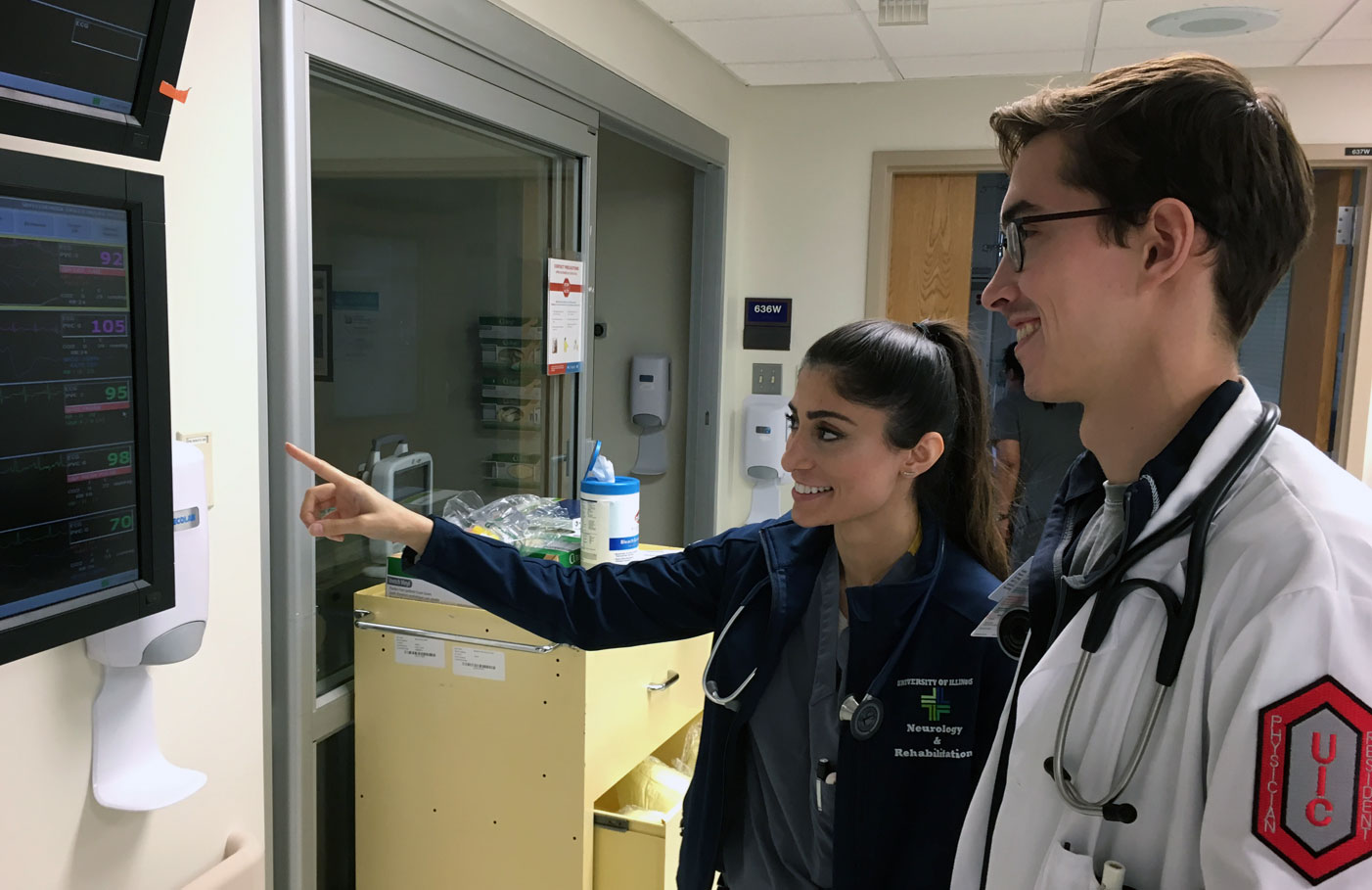
To
see a representative housestaff photo click on photo.
A
general guide to our curriculum is shown below.
PGY-2 YEAR
During
the PGY-2 year ten months are spent learning clinical neurology
at the University of Illinois Hospital, Advocate Christ Hospital
and the Jesse Brown Veterans Administration Hospital. Daily ward
rounds are supervised by an attending neurologist. Residents and
students present newly admitted cases to the ward attending. There
is one month of neuroradiology. At UIC there are two distinct service-lines:
Stroke and General Neurology. Each service covers ward patients
and consults.
PGY-3 AND PGY-4 YEARS
During
the PGY-3 and PGY-4 years, residents complete structured experiences
in neurological consultation, neurointensive care, clinical electrophysiology,
neuropathology, and pediatric neurology. Three months are spent
in electroencephalography with additional training provided in
sleep and evoked responses. [A one-year ACGME approved fellowship
in Neurophysiology is offered under the direct supervision of
Drs. Kaydonova, Rowin, Hughes, Meriggioli, Tomyanovich.]
During
the EMG rotation, the peripheral nervous system is studied intensively.
Nerve conduction velocity and electromyography studies are performed
under the direct supervision of our electromyographers (Drs. Rowin
& Meriggioli). Emphasis is placed on the planning and performance
of studies. Additional experience is gained under the supervision
of Dr. Tomyanovich at the JBVA and Dr. Itkin at Christ Hospital.
Emphasis
during the neuropathology rotation is on gross and microscopic
pathology. The resident reviews frozen section biopsies obtained
during surgery as well as autopsy specimens under the supervision
of Dr. Tibor Valyi-Nagy. Extensive teaching files are available
for self-directed study. A biweekly UIC Neurology Departmental
clinical Neuropathology conference is held at NPI.
During
the pediatric neurology rotation, the resident spends one month
at Hope Children's Hospital and two months at UIC. Infants and
children are examined under the supervision of Drs.
Macmillan and Goldbarg at UIC and Dr. Bob Egel and his staff
at Hope Children's. At UIC the resident attends six weekly pediatric
neurology clinics and serves on the child neurology inpatient
consultation service.
A rotation on the Psychiatry service offers the resident insight
into chronic psychiatric illness and its pharmacological management.
A one or two month experience at UIC's outpatient or in-patient
psychiatry services and/ or at the WSVA consult/liason psychiatry
service is the venue for training. UIC's Psychiatry training program
is nationally recognized and is the largest in the state.
Residents
have an opportunity to serve on the Neurology Consultation Service
at each of the three major teaching hospitals affiliated with
the residency program. In addition, the resident acts as a teaching
assistant in the neuroanatomy course taken by medical students.
SELF STUDY CURRICULUM
The
Neurology Department maintains a comprehensive self-study Web based
curriculum on its intranet specifically designed to meet the educational
needs of our house staff during their three years of training. Board
review sections, resources for many of rotations, key articles,
powerpoint lectures, and important protocols and guidelines are
provided for self study. The Department Intranet system incorporates
recent AAN practice guidelines to assist residents in evidence based
learning.
ELECTIVES
The
head of Neuroradiology is Ed Michels, M.D. and the section includes
Masoud Hemmati, M.D. (Dept. Head), Keith Thulborn, M.D., a prominent
figure in the field of functional MRI, and Dr. Vic Henderson and Dr. Sinha Roy (Interventional
Neuroradiology). UIC has outstanding neuroimaging facilities which
offers our residents all aspects of neuroimaging at a state of the
art level. In addition to a weekly neurology department neuroradiology
conference, the division offers our residents a one or two month
elective. At UIC, all films are digitized and available for viewing
on a PACS system. In addition, our residents become acquainted with
the most advanced interventional neuroradiological techniques.
A
Neuro-Ophthalmology elective with Dr. Anil Gulati provides the
resident with exposure to visual field testing, optic nerve disorders,
visual evoked responses, and eye movement disorders. The resident
spends time at the Illinois Eye and Ear Infirmary.
The
Neuropsychiatry elective provides an opportunity to study neuropsychological
testing and neurophysiological correlates (late evoked potentials,
EEG brain mapping). The Neuropsychiatry service runs a busy out-patient
diagnostic clinic. Dr. David Nienhuis (Neurology) or Dr. Neil Pliskin (Psychiatry) can supervise this elective.
The
Neurorehabilitation elective is offered through our division of
rehabilitation. This elective offers intensive experience in the
rehabilitation of patients with stroke, multiple sclerosis, Parkinson's
disease and other disabling neurological illnesses. Dr. Linda
Laatsch, an expert in cognitive rehabilitation, provides an introduction
to cognitive rehab techniques.
The
UIC Stroke Center elective offers the resident exposure to clinical
research trials in stroke, vascular dementia and related disorders.
Those with interests in neuroepidemiology, neuroinformatics, clinical
drug studies, coagulation disorders, and neurosonology will find
the experience enriching.
An elective in Neurosurgery offers the opportunity to work with
a dynamic Neurosurgery Department headed by Dr. Fady Charbel.
The Department of Neurosurgery is a center of excellence in vascular
neurosurgery, interventional neuroradiology (with Dept. of Radiology),
epilepsy surgery, neuro-oncology and stereotactic procedures.
They also sponsor an advanced brain imaging laboratory. Faculty
include: Neurovascular and Interventional Neurosurgery - Drs.
Charbel, Hanjani, Lemole, Hersonskey; Neuro-oncology- H. Englehard;
Peripheral Nerve- B. Roitberg; Spine - M.
Barua, M.D.; Stereotactic - C. Slavin.
Dr.
Carol Macmillan supervises a month rotation in Neurogenetics which
allows the residents to review human inheritance, develop his/her
skills in identifying and writing pedigrees, understanding appropriate
neurogenetic tests to order, and keep current on those neurological
conditions with identifiable genetic defects. The resident attends
Neurogenetics clinic (Peds) and patient counseling sessions and
may do a focused project.
EVALUATION
At
the end of the rotation, a written evaluation made by the attending
physician supervising that rotation is sent to the resident. Residents
are observed and evaluated examing an unknown patient in a mock
board setting at least annually. All residents are required to take
the annual American Academy of Neurology In-Service Training Examination.
Each resident undergoes supervised examinations to
prepare him/her for ultimate ABPN Board certification. The Program Director
meets with residents twice yearly to review their progress. Residents
are evaluated according to ACGME core competencies.
OUTPATIENT CLINICS
Throughout
the three-year program, each resident spends at least one half-day
in the clinic following outpatients assigned to him/her. Over 11,000
visits are made annually to the Neurology Clinic at the University
of Illinois. An alternative clinic experience is offered at the
busy Jesse Brown VA Out-Patient Center. The clinic epxerience provides
an opportunity for long-term follow-up and evaluation of patients
with Parkinson's disease, multiple sclerosis, myasthenia gravis,
stroke, headache, epilepsy, and other neurologic conditions. An
attending neurologist supervises each Neurology Clinic session.
At UIC the Neurology Clinic is staffed by two full time nurses and
a full-time pharmacist. While the residents are in the EEG or EMG
Laboratory, they spend an additional half-day per week in the Neurology
Clinic performing consultations or outpatient lumbar punctures.
In addition to the patient areas, the clinic area houses a small
lecture hall, a conference room, and library. Computers with extensive
literature databases are available for resident use.
NIGHT-CALL
Residents
take in-house call at the University of Illinois Hospital. Cases
are discussed with a senior resident and/or an attending. When necessary,
the back-up resident or attending is called in to further evaluate
the patient. Each resident is on house call approximately every
fifth to sixth night during the first year and progressively less
each year.
FACULTY
Please
see our Faculty and Faculty
Interest Groups link for a listing of faculty by specialty.
TEACHING CONFERENCES
Teaching
conferences are held throughout the year and include Neuroradiology
(weekly, conjoint monthly with Neurosurgery/Neurointerventionalists),
Brain Cutting/Neuropathology (biweekly), Neurology Grand Rounds
(weekly, conjoint with Neuropsychiatry monthly), EMG (weekly) and
in preparation for boards a Neuroscience Review Course covers neuroanatomy,
neurogenetics, neurophysiology, neuropharmacology, neuropathology
and advanced clinical topics. (For this past year's Intensive Neuroscience
series please see the link on the Departmental
home page.) Conferences in Neuro-ophthalmology, Child Neurology,
Neuropsychiatry are held. Special lectures by visiting professors
occur throughout the year.
SPECIALIZED CLINICAL PROGRAMS
The
Departments of Neurology and Rehabilitation, Neurosurgery, and Psychiatry
jointly operate a Comprehensive Epilepsy Center that provides a
variety of services to epilepsy patients including access to drug
trials and epilepsy surgery. With over 1200 patients and 3000 patient
visits per year, the Epilepsy Center is the largest such program
in Illinois. The Epilepsy Center maintains two video-monitored EEG
beds in the University of Illinois Hospital.
In
cooperation with the Department of Neurosurgery, the Department
of Neurology and Rehabilitation has created a Comprehensive Stroke
Center. Patients in the Comprehensive Stroke Center have access
to the latest therapeutic and diagnostic modalities for stroke
including innovative drug trials for acute stroke and stroke prevention.
Over 200 acute stroke patients are treated each year. All stroke
patients are registered in the UIC Stroke Registry. The Department
of Neurosurgery offers specialized vascular bypass procedures
that are available at only a few medical centers nationally.
Under
the direction of Deborah Little, PhD (Head, Section on Functional
Neuroimaging) our residents may elect to participate in functional
imaging in the UIC MRI center utilizing both routine and research
protocols.
CLINICAL LABORATORIES
The
Department of Neurology and Rehabilitation operates two clinical
laboratories within the University of Illinois Hospital. The Electroencephalography
Laboratory offers exposure to a variety of diagnostic tests including
electroencephalograms, ambulatory electroencephalogram, video-monitored
electroencephalogram, intra-operative electroencephalograms, evoked
potentials, and intra-operative evoked potentials. The Electromyography
Laboratory offers residents the opportunity to perform electromyograms
and nerve conduction studies.
RESEARCH
The
Department of Neurology and Rehabilitation has a broad scope of
clinical research programs that offer residents many opportunities
to participate actively in research on neurological disorders. Residents
are encouraged to develop research projects in collaboration with
Neurology Faculty actively engaged in research. See Faculty
Interest Groups link.
BASIC NEUROSCIENCES
The
University of Illinois at Chicago is a major research university
with over 80 scientists working in the neurosciences. Neuroscientists
are organized in a university-wide Committee on Neurosciences. The
Department of Neurology and Rehabilitation interacts actively with
neuroscientists throughout the University providing research opportunities
for neurology residents.
SAMPLE RESIDENT AGREEMENTS
Link
to
Sample Resident Agreements from the GME website
LIVING CONDITIONS IN CHICAGO
UIC
Medical Center is located in the vibrant Illinois Health Center
District. Within walking distance is "Little Italy" on Taylor St.
with numerous restaurants. Greektown is a 5 minute drive from the
medical center. The United Center (Bulls, Blackhawks) is 4 blocks
from the medical center. There is an elevated train stop (L-stop)
on the campus with quick access to the loop. Resident applicants
will have many nearby neighborhoods to choose to reside including
Lincoln Park, Gold Coast, Lake View, Oak Park, River North, Bucktown,
Printer Row, Skokie all less than about a 30 minute drive. There
are several nearby apartment buildings walking distance to the medical
center. Numerous inexpensive suburbs with easy access to major expressways
are other alternatives. The East campus of UIC (non-health related
graduate schools and undergraduate school) is about 1 mile east
of the West Campus (medical school, medical center, dental school,
affilitated health professional schools). A large well equipped
modern student
union is located on both campuses with complete and extensive
recreational facilities. For further housing and university information
please check the university
website.
Related link - Exploring
Chicago website.
For Applications and additional information:
Steven
U. Brint, M.D. sbrint@uic.edu
Director |
Sean
Ruland, D.O. sruland@uic.edu
Assistant Director |
Neurology
Residency Training Program
Department of Neurology and Rehabilitation (M/C 796)
University of Illinois at Chicago
912 S. Wood Street
Chicago IL 60612-7330
Telephone: 312.996.6906
Fax: 312.996.4169
Internet: neuro@uic.edu |
|